Pyris Shield · SOC Operations Layer
Thousands of signals. A few cases.
AI security operations on top of the SOC and SIEM you already run
Correlation across every source, validation by several AI models and investigated cases delivered into your team's service desk.
Real?
Correlated across sources and confirmed with quorum in the model council.
How far?
The asset or identity, its owner, its criticality and its blast radius.
Now?
The same log line next to a CVE that joined KEV two hours ago.
Actionable?
A typed playbook with the evidence trail, straight into your ITSM.
Real console screens
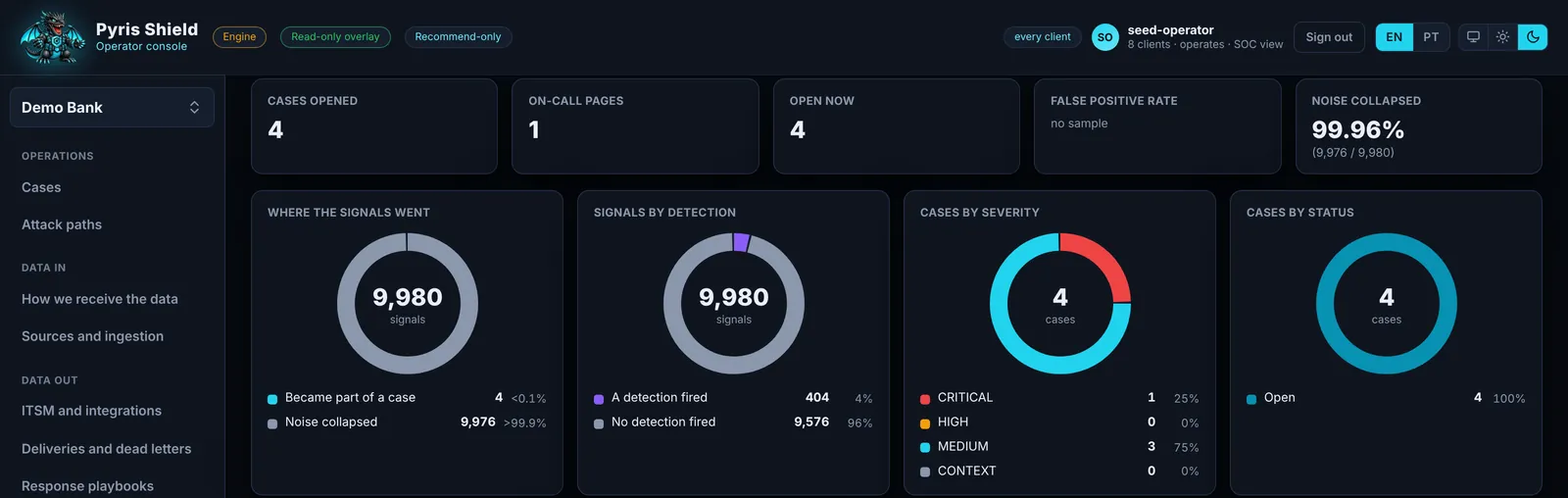
Dashboard
SOC operations on one screen: what came in, what correlation and policy silenced with a reason, what the council confirmed and the open cases, ranked by impact and urgency.
What sells
Attack Path
Every case drawn as the path the attacker took: the origin, the MITRE ATT&CK techniques, the assets and identities hit and how far the impact can reach. In the demo: 15 steps, 11 entities, 8 tactics and 10 techniques.
- Built from the case evidence, never invented by a model
- It is the picture an analyst takes to the incident call
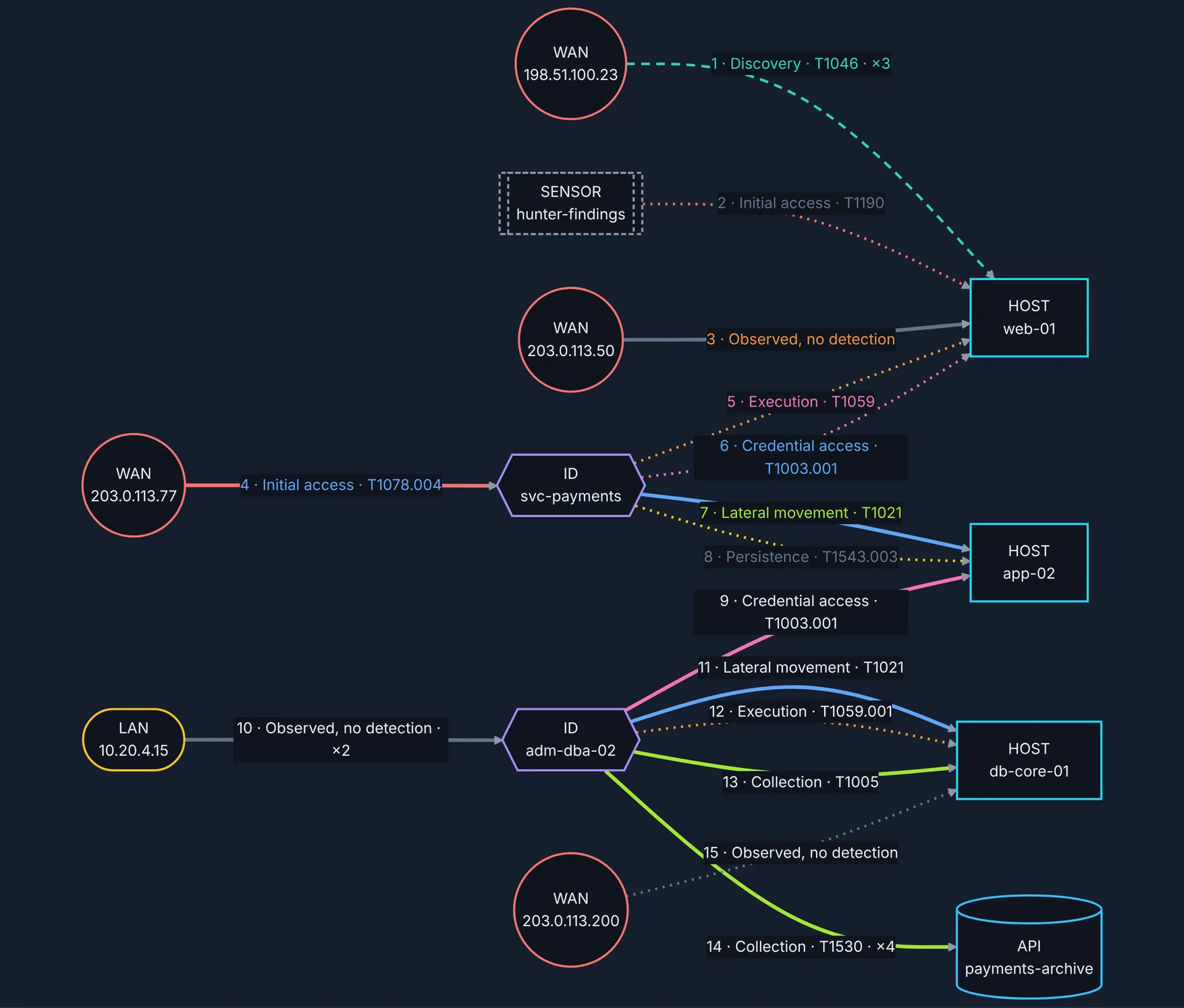
Real console screens with a demonstration tenant, with fictitious data.
See Pyris Shield on your own environment
A 30 minute walkthrough with our specialists, using a demonstration tenant and your own use cases.
What it is
Pyris Shield is the security operations platform a SOC runs on: detection, triage, investigation, case management and response orchestration. It takes the customer's telemetry in OCSF, plus the alerts of any external SOC or SIEM, correlates them, validates every candidate in a council of AI models and delivers a few fully investigated cases. It is the engine behind CROSS-INTEL SOC as a Service.
Why it is different
An overlay, not a SIEM: Shield works on the telemetry you already store, with no tool to replace and no ingestion bill.
Outcomes
- Queue by confidence, impact and urgency
- False positive rate measured, not guessed
- Reports computed from the records
- Multi tenant for MSSPs and managed SOCs
Core capabilities
- Wazuh, Splunk, Microsoft Sentinel, CrowdStrike, Google SecOps and cloud EDRs as sources
- Enriched by Pyris Identity, Sentra, Hunter and Intelligence: identity, asset, blast radius and proof
- Sigma detections from Pyris Intelligence, evaluated in flight without storing the record
- A model council with quorum, confidence computed in code and auditable votes
- Cases in ServiceNow, Jira and GLPI; notices in Slack, Teams, PagerDuty and email
- Optional response with human approval, a second confirmation and reversal
Innovation
What sets it apart
Agent and Agentless
API pull with nothing to install, or a light collector in your network with mTLS and masking at the source.
Customer kill switch
The customer pauses collection per tenant or per source, and the pause is recorded as a gap.
Typed playbooks
The whole recommendation: the proposed playbook, the ones that failed and why.
Third-party SOC
The SIEM the customer already pays for becomes a source and, later, an action target.
Executive reports
Computed on demand from the records, always saying what is still open.
Autonomous response
Execution in Falcon, Defender and more, with quorum, opt-in, two approvals and reversal.
AI narratives
Written over tokens and finished in code: nothing sensitive leaves the estate.
PT, ES and EN
Investigation in the analyst's language, with the market's vocabulary.
Benefits
Fewer than ten cases a day
Five sources seeing the same scanner become one context entry, not five alerts.
No tool to replace
Analysts work in the service desk they already use, and the closure reason becomes a metric.
Auditable silence
Every suppression has an expiry and a reason. Nothing is silenced off the record.
Your data stays yours
Fields masked inside your network and no raw telemetry kept.
Built for
Deployment
Operating modes
Request a demo
Want to see Pyris Shield in action?
Tell us a little about your environment and a specialist will reach out within one business day to schedule a personalized demo.
- Live walkthrough of the Dashboard and Attack Path
- Mapping to your use cases and compliance needs
- Deployment options: SaaS, on-premises or air-gapped